‘Writing For God’ – a beginner’s guide

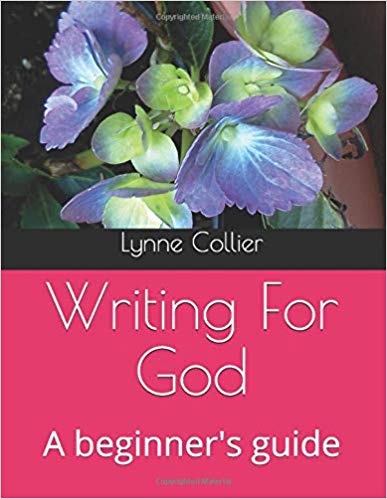
You’ve decided you want to write for God but now what? Most writers who feel they want their work to count for God’s kingdom in some way start out with that question. We don’t know how to write for God, what He wants from us, how to write what we feel He’s asking us to write, or how to get that out into the world when we’ve written it. Does it seem like a daunting task to write and publish something and even more so when our main audience is God Himself? I break all of that down in my new book,

Writing For God – a beginner’s guide.

The workbook has pages to jot down your thoughts and collect all the information you need as you discover how God created you for this new adventure. You’ll be able to decide what genre suits you best, which format aligns with you as a created individual, your natural talents and spiritual gifts, and how your personality shines through your work.

You’ll also see how you already have the experience you need to start writing now and hone your craft as you build your portfolio.

God does not call those who are equipped, He equips those whom He has called.” — Smith Wigglesworth

Don’t be fooled into thinking you have nothing original to write about. No one else has had the exact same experiences as you, so anything you write will be unique and from a different perspective. Write from your heart and people will be blessed

Til next time, remember you are created in the image of God who loves you very much.

~ Lynne

Check out my book on Amazon — http://bit.ly/2sPxQA0

Write A Book In 10 Hours!

MARCH 13, 2019

How would you like to write a book this week?

Through my writing career, I’ve discovered a quick and easy way to create a short story or info book in about ten hours. So Kirstie (my digital designer) and I have been busy putting together five new workbooks for authors of stories and writers of nonfiction and we’re ready to launch the first one!

It takes approximately ten hours to write enough content for your book plus a short revision and you’ll be ready to publish. We’ve added worksheets to help you brainstorm and posters to inspire you as you write. We even give tips on marketing so you’ll be off to a great start right after you hit ‘launch’. The best part is you probably have enough content on your social media platforms already, you just need to organize it into a publishable book.

Workbook to help you write a book in ten hours.
From Blog To Book – the From-To Writing Method

From Blog To Book: The From-To Writing Method series. Now available as a printable workbook on Etsy

So what do you say? Would you like to get that book finally written?

Happy Writing!

Lynne

Writing Fantasy || Point of View

Whose Point Of View Matters Most In Your Story?

The answer to this question will play an important role in the tone of your entire novel. We listen to other people probably every day in one form or another, in personal conversations, a lecture at school, a boss or characters on a TV show. Notice how the tone of their voice influences you. What tone do you want to convey in a particular scene or throughout the entire story?

  • Interesting
  • Funny
  • Lively
  • Friendly
  • Romantic
  • Quarrelsome

The characters telling the story have their own unique voice and, depending on that voice, will tell a scene in a specific way.

8 Points to Ponder when Writing Point Of View. Writing tips.

8 Points To Ponder For Point Of View

  • Have you thought about what tense you’ll write in? Will your story read better in past tense or present tense? Past Tense – “Suzie shopped at the mall”.
  • Present Tense – “Suzie is shopping at the mall”.
  • When you sit to write each scene, who do you hear talking in your mind?
  • First Person – “I love doughnuts”.
  • Second Person – “You love doughnuts”.
  • Third Person – “Suzie loves doughnuts”.
  • Omniscient (aka, all-knowing) – “Suzie loves doughnuts but she doesn’t realize they’re laced with a powerful hallucinogenic”. Use this voice sparingly, as when none of the characters knows something but your reader needs to know it.


Choose Your Narrators

Just like in a movie audition, test your characters’ voices to see which point of view sounds best for each scene. You may want to do several viewpoints throughout your story, but remember to not switch viewpoints in the middle of a scene or chapter unless you make a specific break in the narrative. It confuses the heck out of the reader. If you’re new to writing fantasy/fiction keep it simple and write one POV for each scene. You may feel like you want to write the entire story from one POV, but test other voices to see if you can spice things up, add some humour or simply add a different perspective to delight the reader.


Voice Test for POV

Write a paragraph from the author’s POV. This means you just write out the paragraph as it happens, without emotion or opinion. Then write it out in all the voices of your characters who are in that scene. Let them say what they feel and what they’re thinking.

  • Who sounds good for this particular scene?
  • Who has an emotional investment in what’s happening?
  • Who will it influence later in the story as your plot unfolds?
  • Who sees something no one else does?


Example:

  • “Suzie went to the mall again. I hope she’s not spending all her money. She still has two weeks before her next paycheck”.
  • “She went to the mall again. Who does she think she is, buying all those fancy expensive clothes? They look ridiculous on her anyway.”
  • “Suzie went to the mall this morning. She needed to choose a dress for her grandmother’s funeral”.

Do you see how each character changes the tone of the scene? What were they thinking and feeling? Ask them why. Draw the scene out from your chosen character’s point of view.

Til next time, know you are loved by the One who created you in His image.

Lynne


Resources to check out

Back To The Future – where the twists are revealed by other people’s POV and by the main character.


Writing Fantasy || Society

Who Lives In Your Fantasy World?

We have the freedom to create an entirely new world from our own imagination! How amazing is that? We get to decide everything that happens in this world and who lives there. We’ve already decided what our world looks like. Now we’re going to decide how our world works so we can write a society for our fantasy characters to live in.

fantasy-society-lynne-collier-blog
art by kellepics


Your World’s Society, Technology & History

Before you can create your characters you’ll need to know what goes on in the world around them and how they fit into this world. However, if you’ve already drawn up an extensive list of characters and decided what they eat for breakfast, no problem, don’t waste all that creativity, just build the society around them and let it unfold from there.

Here are some things to consider about your world:

Social Norms

  • What kind of work do they do?
  • What significant events have shaped the history of this world?
  • What’s their educational system like?
  • Do they own businesses or trades?
  • Are there male and female or children and how do they develop?
  • What religious beliefs are in play? How do they worship? Write down some of their moral values.
  • Is there a law enforcement system? How is it run?
  • Is it a democratic society, dictatorship or monarchy?
  • How do they communicate? Is there more than one language?
  • What about transportation?
  • How do your characters communicate long distance?
  • What do they do for fun
  • Does your world run on electricity, steam or natural resources?
  • Are there warring factions?
  • What are their weapons?


Ask Yourself, “If This Is True, Then What Needs To Happen?”

• If characters go to work in cities, then where do they live?
• If they live in high-rise buildings, then how do they get to the top floors?
• If by elevators, then how are they powered?
• If by electrical power, then how is it generated?
• If by water, how is it produced?
• If by rain, how is it stored?
• …

You get the idea. Here we have characters that live in high-rise buildings where they get to their apartments by taking an elevator which is powered by electricity produced by water which is held in reservoirs outside of the city.

You can go on from there, filling in the “If This, Then What..?” questions until all the questions about your characters’ needs are met in their world. You only need the details that are relevant to the characters. There’s no need to write lengthy, unnecessary descriptions which aren’t relevant to your story and will only bore your readers. You just need to know how they do what they do.

Remember to show this in your writing, don’t tell it. (More on this later).
You may need to go back and add transportation routes, such as wide rivers and ports for boats, roads for trades’ people, or something like train tracks to your world map — grab the cheat. Add any changes as you write your story so you don’t forget the details.

The easiest way to figure this out is to put yourself in the shoes (hairy feet, hooves) of your characters. Walk around in your world as if you were there and see what you need.

Have fun!  #writingfantasy

Til next time, know you are loved by the One who created you in His image.

Lynne

Writing Fantasy || World Mapping


Mapping Your Fantasy World

When we write fantasy stories we need to decide where the story takes place. This is called ‘mapping’ and can be an artistic rendering of the world where your story lives, or it can be a topography of the terrain drawn like an actual map with all the hills, valleys, rivers, roads and towns. I prefer to collect Pinterest pins, but at some point, I need to discover what components make up my fantasy world and literally how long it would take a Dwarf to get to the Castle Keep. So, a drawn or written map is essential to the span of time for him on his travels.

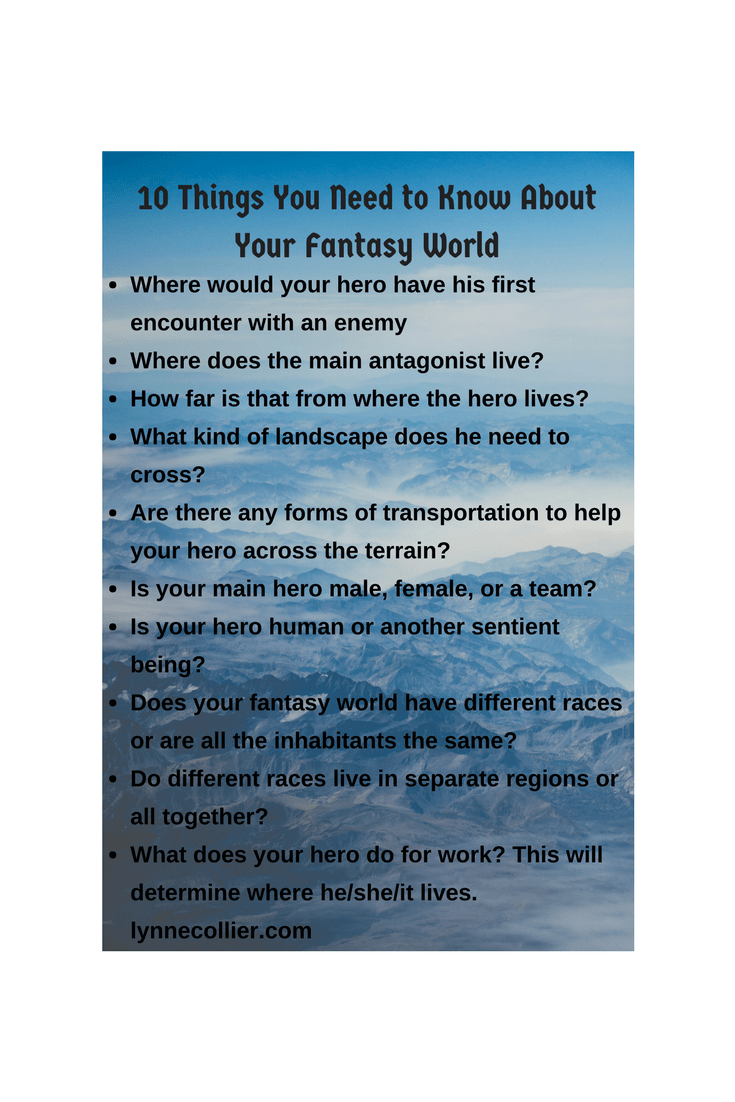
10 things you need to know about your fantasy world before you begin writing your novel.

If it takes a few days for the journey, then I know to add an adventure, altercation or meeting with someone along the way, because let’s face it, a journey without an event is just plain boring and not at all interesting to your reader. In real life we couldn’t travel three days without meeting a fellow traveller, missing a bus connection or experiencing bad weather. So it is with other worlds. That’s where the storyline unfolds, in the in-between times.If you’ve already decided on a rough outline for your story (more on this later if you haven’t already started one), now is the time to decide how big your fantasy world needs to be in order to incorporate all the events you have planned. Even if you don’t have an outline written down, you’ve probably envisioned an encounter with an enemy, a chance meeting with someone, and a plot twist somewhere. What kind of backdrop needs to be in your world for these events to happen? Walk around in your world a while.

Far Over The Misty Mountains Cold”, from The Lord Of The Rings (you can see it on YouTube), describes the terrain beautifully and sets the scene for the Dwarves’ backstory and imminent adventure.

Your Hero’s Lifestyle

 “…using real places as a springboard can help you frame elements consistently and with a more grounded result” – Ammi-Joan Paquette, author and literary agent explaining mapping in Writer’s Digest, March/April edition 2016.

Look around your real world. Do you see the potential for mapping your fantasy world based on reality?

I often draw from my childhood memories of the hills and dales of England, where the Bronte sisters gathered most of their inspiration. You can find some of those places on my Pinterest board, West Yorkshire England

10 more things to consider before you write your fantasy story.

Fantasy Inspiration

Who were the authors who shaped your childhood memories of fantasy and make-believe? These are the writers we tend to remember the rest of our lives. My childhood memories of magical and fanciful tales come from four well-known children’s books:

The Secret Garden by Frances Hodgson Burnett

The Magic Faraway Tree and Noddy by Enid Blyton

Rupert The Bear by Alfred Bestall (originally created as a comic strip by Mary Tourtel)


Your Next Step

Draw or describe your own fantasy map and copy to your secret Pinterest inspiration board if you’re not ready to share it with the world yet. Here’s a link to my Fantasy Inspiration board which is public, but I have a secret board I’ll share once my novel is published. Or pin your inspiration to a board you’ve created to share your work with your followers. I’ve done this with my Dwarf Book I’m Writing. Another way is to cut out pictures from magazines and actually pin them to your office bulletin wall or stick them to your fridge with a crazy magnet.

Comment on how you were inspired for your creation and where you post/pin/stick your inspirational images/words. I’d love to hear about the world you’ve created.

Til next time, know you are loved by the One who created you in His image and gave us this beautiful world to live in.

Lynne