In April, after the snow melts and doesn’t return before the progging is done and the soil is tilled I put pencil to paper and delight in planning my pots and plotting my plants.
The problem with our zone 4 gardens is that the weather has changed dramatically over the past few years, and we sometimes have snow left on the ground when the temperature suddenly rockets to 29 degrees (C).
Because of this, many plants that used to survive the early spring here no longer do. Now, we wait until May 25 to plant our new perennials and annuals when the risk of overnight frost has passed. That’s a long weekend here in Canada and a perfect time to plant new things in newly tilled soil.
I’m happy to plant again this year to celebrate the healing of my broken arm. My favourite colour is purple, so I’m planting this beauty as soon as possible. If it turns out lovely, I’ll take a photo.
rough sketch of a pot idea
Plants — Salvia, Coral Bells, Dusty Miller and Petunia.
*note: “Progging” is an old English word for searching for anything and is widely used to describe the collection of fallen branches and twigs. We use it often in April at White Rose Shire as we experience many storms that down the trees in the woodland surrounding our gardens. I’m chuffed to hear my grandkids use the word whenever they talk of spring at our place.
I’m so happy to be outside in my gardens again–finally!
If you’d like to support my writing, please subscribe to Medium to get access to all my stories and poetry, as well as stories by hundreds of other writers. If you subscribe to my profile, you’ll also receive an email when I publish new content. Thank you so much!
The first thing to do in spring — take down the Christmas lights!
Lynne
The second thing I do is the annual walkabout to see what we have to deal with as far as cleanup.
The January and February snowstorms leave a mass of broken branches and debris everywhere here in southern Ontario. And cleaning it up can take several weeks.
After removing all the decorations from the past Christmas, my husband and son pick up the heavy branches and tree limbs that have fallen. I follow them, picking up the smaller branches and pruning dead ones.
The Walkabout
After the fallen branches have all been moved to the landfill, I finally take stock of the landscape. I walk around the planted gardens, woodland and riverbank with my camera and notebook, taking photos of things to change.
I note any large items I need for interesting focal points and relocate anything out of place before planting my new perennials. I try not to use too many annuals unless I run out of perennials to split. This cuts down on cost, and perennials tend to mound, cutting down on weeds too. Although I do have some favourite annuals I like to use in containers on my deck.
Then, I sit with a cup of tea by the river and write my notes. Sometimes, when a large area needs a different design, I also need graph paper to make sure I get the dimensions correct. I learned soon after digging the first gardens to be aware of where I need new plants and how tall and wide they’ll grow. So many times, in the beginning, I had to relocate something because it was in the wrong light or overshadowed smaller plants.
Writing notes also helps me decide if I need to change things with a view to my garden’s foundational aspects, such as trees, statuaries and bushes. I generally do this in the fall but sometimes things grow unexpectedly or a storm demands changes in the spring too.
The Lenten Rose
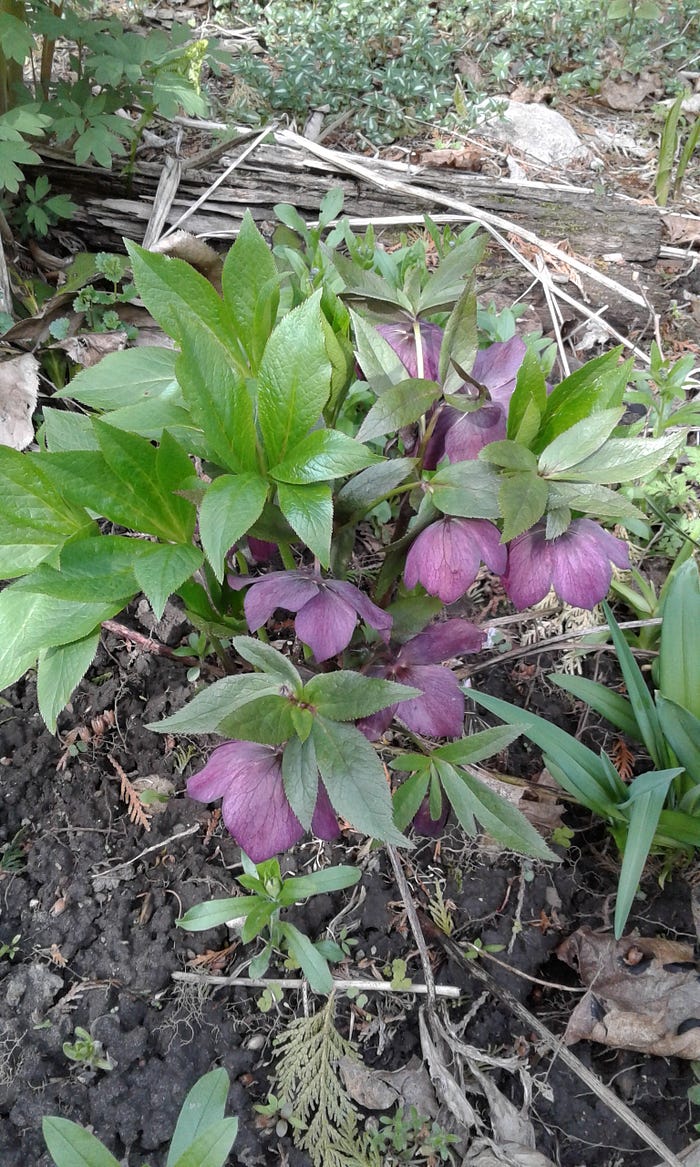
I’m always overjoyed to see my Lenten Rose survive the extremely long winter months. The leaves, a mound of green under the melting snow, bring such hope when they begin to show their colours. Before the ground thaws, these magnificent blooms reach out through the frozen mulch from the previous year to greet us with the promise of a new spring.
Its recorded history dates back centuries when it was used as a medicinal plant. It became known by the common name Lenten Rose because it blooms during the season of Lent. It’s a favourite of many traditional Victorian gardens and ideal for the climate of my zone 4 shade garden.
photo by Lynne Collier
Lily-of-the-Valley
Every year we have an invasion of those plants we love but can’t control. For example, we’re currently battling a sea of Bugleweed in the clearing. Soon, the plant I really hate to love — Lily-of-the-Valley — will be sprouting everywhere in the woodland. In spring, the clusters are so beautiful when the shaded woodland is primarily dormant. Still, the plant can be invasive if I don’t want it to spread to other locations.
Lily-0f-the-Valley is also known as Mary’s Tears due to its blooming time around the Christian Easter event of the crucifixion of Jesus, when his mother, Mary, wept at His feet.
The Lily-of-the-Valley produces strands of small, bell-shaped flowers on top of a single stem above the leaves. The flowers are incredibly fragrant and are used in perfumes and potpourri. It spreads prolifically by rhizomes and grows in the shade where the ground is moist. We find it in large groupings throughout our woodland and the river banks, where the soil seldom wholly dries out, even in the hot summer months.
Though beautiful and fragrant, this plant is extremely poisonous! I always wear gloves when I’m handling it.
One way to rein in the offending invaders is to put them in pots. First, I bury the pot in the garden with the rim flush with the soil surface. Next, I make sure the pot has holes in the bottom for drainage. This holds back plants that multiply by tubers or spreading roots. If the pot becomes crowded, I divide them in spring or move them to a bigger pot. These plants are great as fast-growing groundcovers but will overtake an area quickly if not kept in check.
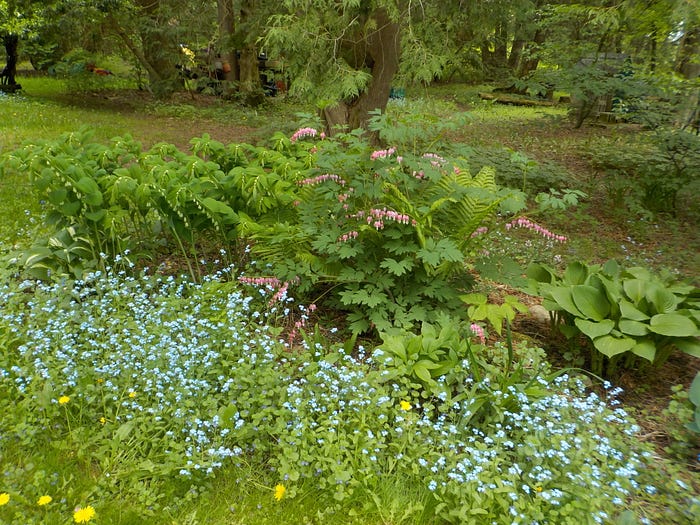
Two more of my favourite groundcovers are the English Bluebell and the Forget-Me-Not, which bloom here in early May. I split these after they flower and fill in bare patches at the woodland edge every year. They self-seed and are very hardy.
I’m happy to see they’ve usually doubled in number the following year. I grouped the plant here in a shade garden with Bleeding Heart, Solomon’s Seal, Hosta and Fern. I also leave dandelion in spring for the migrating butterflies.
photo by Lynne Collier
Here’s a Tip for Next Spring
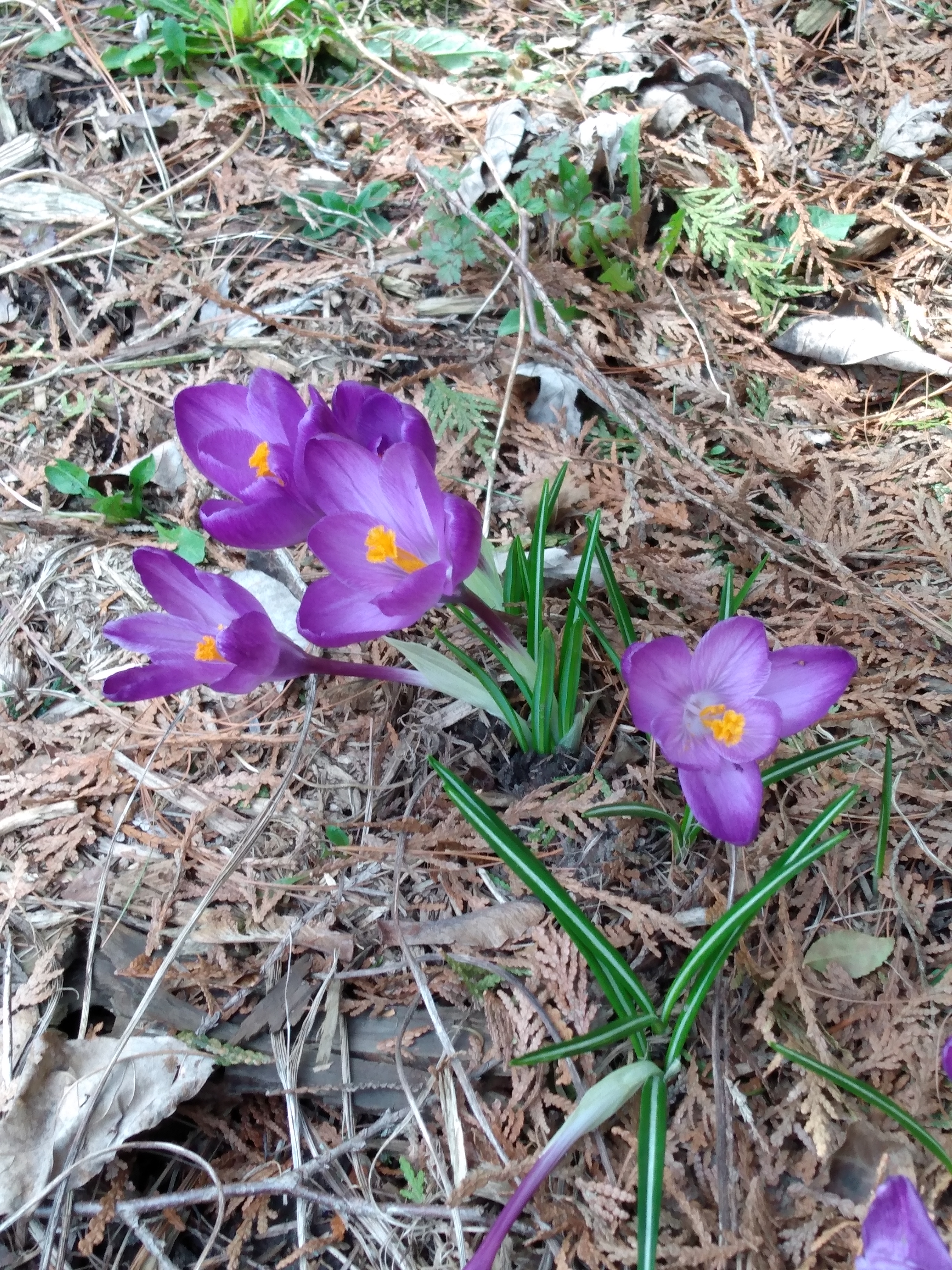
After the spring plants have finished blooming, I dig up the spent bulbs and plant them directly in the garden using the layering method. Or I plant them in a pot in the ground to over-winter the bulbs. In spring, I take the pots out of the ground as soon as the ground thaws and water them thoroughly. They also make excellent inserts, and I love to display them in decorative containers on my deck.
I also like to leave some pots in the garden after the blooms are spent. This gives me a continuous show of colour next spring, and I find the bulbs will multiply to expand my collection or share with friends.
Spring bulbs are also easy to grow indoors at the end of winter and make wonderful Mothers Day and Easter gifts.
Two ideas for spring bulbs to give as gifts or adorn your own home
1. An easy gift to make; choose a glass or clear plastic container, fill the bottom with pebbles or small rocks or similar material, place the bulbs on top of the stones with the roots down, and water thoroughly. Keep the bulbs covered with water, and a beautiful display will bloom. It makes a stunning centrepiece and the bulbs can be planted outdoors, ready for next year.
Daffodils and Narcissus are beautiful in a vase for spring, as are Tulips and Hyacinth. I love to watch the roots spread in the water.
2. Layering; place approximately 2″ of potting soil in a large pot, layer your bulbs starting with the ones needing to be planted deepest, add 1″ of soil on top of them, then your medium-sized bulbs on top of those being careful not to place them directly above the first bulbs, put another 1″ of soil covering those, then your smallest bulbs above them, cover the top layer of bulbs with 2–3″ of soil to the rim of the pot, pack down lightly and water thoroughly.
I like to use crocus, tulips and daffodil for this layering technique.
’Til next time — I hope you’re enjoying the much-anticipated warmer weather if you’re in spring where you are. But, if you’re in winter — I feel for you!
~Lynne
Follow more stories about Life at White Rose Shire:
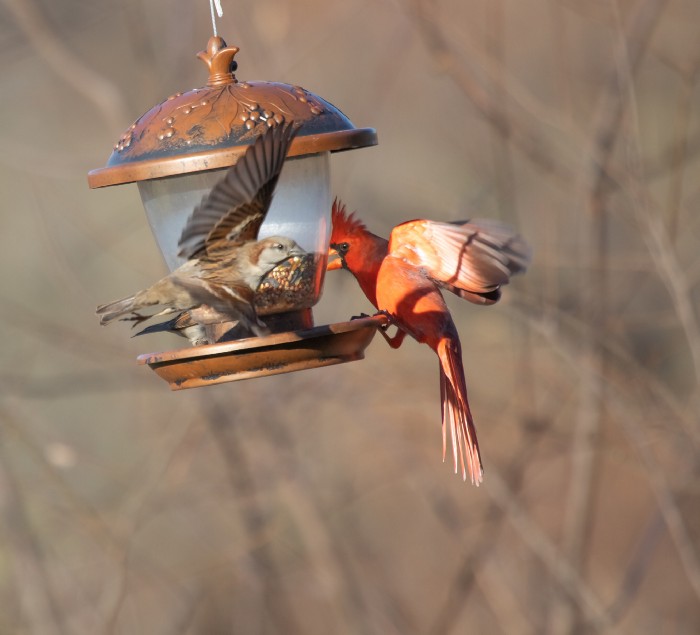
The birds flew from the budding cherry tree above the feeder as soon as I threw the seeds inside. Squabbling over the perch, they vied for their position in line. I smiled as I watched the familiar battle of wills and listened to their chirps of disagreement. It wasn’t long before the squirrels and chipmunks heard the sound of the feeder being stocked and joined in the conversation. Another pleasant morning in my garden.
But something caught my attention as I turned to take the seed scoop back inside. Something was there that shouldn’t have been there. There was a pile on the side deck. A pile of evidence that a giant beast had passed that way. Inches from where I stood.
I write fantasy
This happened shortly after I began gathering research for a fantasy story that I hoped to write for the upcoming NaNoWriMo challenge. So, all manner of fanciful ideas flooded my brain. Was it a wolf, a coyote, a rabid dog, or worse–possibly a beast unknown to my area, or a werewolf?!
I took a deep breath and tried to think of more plausible explanations. I finally decided it was highly probable it was a wayward dollop of sludge from emptying a flower pot. Maybe.
I called to my adult son to come give me his opinion. He writes fantasy too–more than I do and more successfully (I can brag). And, after aliens with no personal hygiene manners were discussed at great length, he concluded yes, it was obviously a werewolf. He has my sense of humour.
And then this happened
We were still laughing at the antics our creative minds get up to when we’re in each other’s company when I spotted something that stopped me and literally caught my breath. I clutched my gardening gloves to my chest and called out to my son. (He was crouching on the front deck, probably still thinking of the possibility of an alien invasion being the reason for the mysterious pile). He sauntered over to me, and I pointed to the offending site.
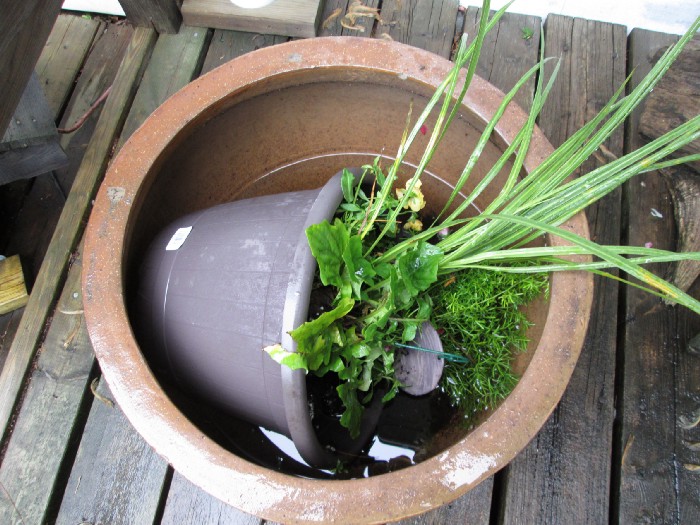
image by author
Not far from the previous mystery, there was something else alarming. It was in the corner of the deck directly under my bedroom window. So, not only had something left a pile of something behind to let us know it had been on our deck, it showed us how intelligent it was too–while I slept!
With its beautiful begonias and narcissus, a flower pot was completely turned on its side inside the ceramic planter. I think I remained frozen to the spot, like a crazy-looking garden statue, for several minutes. My son stared at the pot, saying nothing. Then, slowly turned to me and said, “What?”
“What?” I exclaimed back at him. Glaring, I pointed to the pot. “It was a huge beast! See, it turned the pot upside down inside the planter! Only a big beastly thing could have done it. The wind couldn’t turn over a pot like that!”
All common sense left me and I remained at a distance from the disturbing sight. I sheepishly glanced about the garden for signs of a terrifying presence. Then, finally, my son went over to inspect the pot. After fiddling about with it for a few minutes, lifting it out and moving it around, he turned to me and grinned.
“Rain.”
“Rain?”
“Yes. Rain.”
He stepped back and proceeded to explain how the weird phenomena had happened.
“It rained heavily last night. The planter probably doesn’t have a large enough hole in the bottom to let all that water drain out at once. The rain collected in the planter and, as the water level rose, it lifted the pot to the surface where a slight imbalance of the planter caused it to tip sideways. The rainwater seeped slowly out of the bottom of the planter, and the water levelled off. The pot sank to rest on the bottom, on its side.”
I straightened myself up and took another deep breath. Although I felt pretty foolish, I took some credit for homeschooling him. I looked at my grinning son.
So, no giant beast or alien invasion?”
“I’m afraid not. Although it would make for a great story.”
’Til next time, I hope you have a lot of laughs in your life and loved ones to share them with and, oh—watch out for the aliens!
~ Lynne
This post was first published on Medium.com
Did you miss my first garden mystery? Here it is —
When I was small we didn’t own land but we were ‘allotted’ a small garden to grow vegetables and flowers if we didn’t have a backyard. I have many fond memories of times planting and harvesting with my great-aunts and uncles. They grew most of their own vegetables. My job was to shell the peas. I giggled every time one popped!
‘Til next time–I hope you can recall some pleasant childhood memories.








 Lynne Collier